
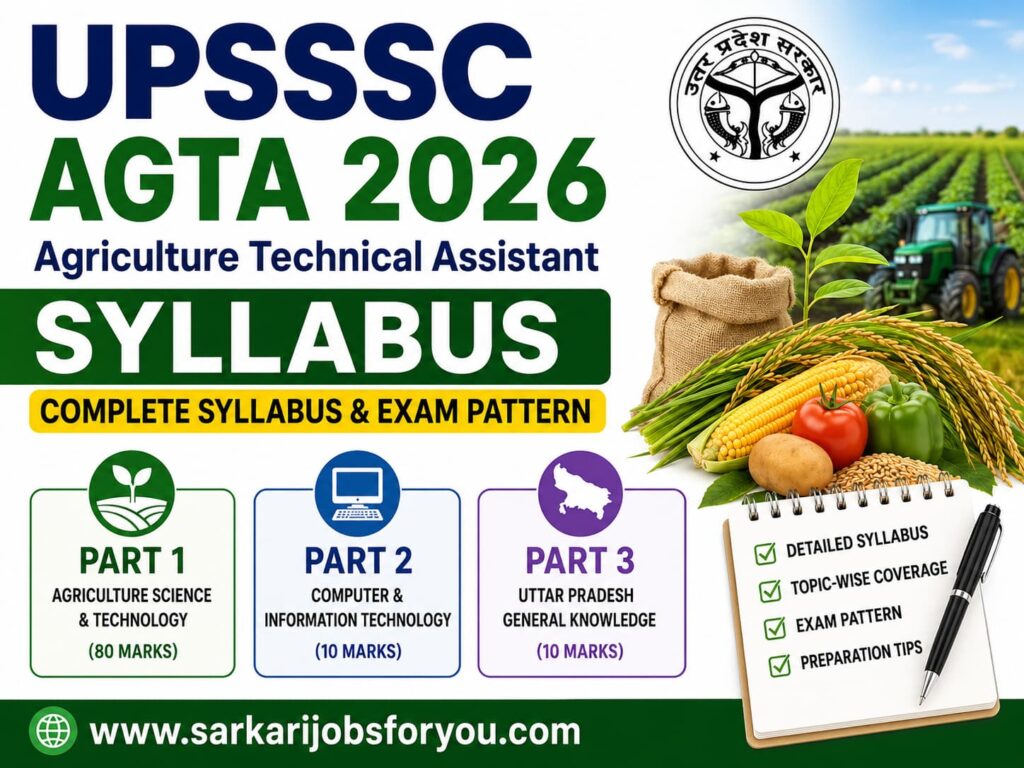
Candidates preparing for the UPSSSC Agriculture Technical Assistant (AGTA) Recruitment 2026 must clearly understand the latest syllabus and exam pattern before starting preparation. The Uttar Pradesh Subordinate Services Selection Commission (UPSSSC) conducts the AGTA Main Examination for recruitment to the post of Agriculture Technical Assistant (Pravidhik Sahayak Group-C) under the UP Agriculture Department.
The AGTA Mains examination mainly focuses on:
- Agriculture Science & Technology
- Computer & Information Technology
- Uttar Pradesh General Knowledge
The Agriculture section alone carries 80 out of 100 marks, making it one of the most agriculture-focused government exams in Uttar Pradesh.
In this article, we have provided the complete detailed UPSSSC AGTA Syllabus 2026, latest exam pattern, section-wise topics, subject weightage, important preparation strategy, and best books for preparation.
UPSSSC AGTA Syllabus 2026 – Highlights
| Particulars | Details |
|---|---|
| Organisation | Uttar Pradesh Subordinate Services Selection Commission (UPSSSC) |
| Post Name | Agriculture Technical Assistant (AGTA) / Pravidhik Sahayak Group-C |
| Advertisement No. | 06-Exam/2026 |
| Department | Directorate of Agriculture, Government of Uttar Pradesh |
| Exam Mode | Offline (OMR-based) |
| Question Type | Objective Type (MCQ) |
| Total Questions | 100 |
| Total Marks | 100 |
| Duration | 2 Hours |
| Negative Marking | 0.25 Marks |
| Official Website | upsssc.gov.in |
UPSSSC AGTA 2026 Exam Pattern
Candidates should first understand the latest examination pattern carefully.
| Parameter | Details |
|---|---|
| Exam Mode | Offline (Pen & Paper / OMR Based) |
| Total Questions | 100 |
| Total Marks | 100 |
| Time Duration | 120 Minutes |
| Question Type | Multiple Choice Questions (MCQ) |
| Negative Marking | 1/4th Mark (0.25) |
| Language | Hindi & English |
Section-wise Marks Distribution
| Part | Subject | Questions / Marks |
|---|---|---|
| Part 1 | Agriculture Science & Technology | 80 Marks |
| Part 2 | Computer & Information Technology | 10 Marks |
| Part 3 | General Knowledge of Uttar Pradesh | 10 Marks |
| Total | 100 Marks |
Important Strategy: Agriculture Science carries 80% weightage in the exam. Candidates should dedicate maximum preparation time to agriculture subjects.
UPSSSC AGTA Detailed Syllabus 2026
Part 1 – Agriculture Science & Technology (80 Marks)
This is the most important section of the examination.
A. Crop Science Syllabus
(Approx. 25 Questions)
Topics included:
- Classification of Crops
- Kharif, Rabi & Zaid Crops
- Botanical Description of Major Crops
- Cropping Systems
- Crop Rotation
- Mixed Cropping
- Intercropping
- Seed Production
- Seed Certification
- Seed Treatment
- Tillage Operations
- Sowing Methods
- Transplanting Techniques
- Irrigation Methods
- Drip Irrigation
- Sprinkler Irrigation
- Water Use Efficiency
- Nutrient Management
- Macro & Micro Nutrients
- Fertilizer Application Methods
- Weed Management
- Herbicides
- Biological Weed Control
- Crop Harvesting
- Post Harvest Management
- Storage & Threshing
- Yield Improvement Techniques
Important Crops of Uttar Pradesh
Kharif Crops
- Paddy
- Maize
- Bajra
- Sorghum
- Cotton
- Sugarcane
Rabi Crops
- Wheat
- Barley
- Mustard
- Gram
- Lentil
- Potato
B. Biotechnology, Plant Breeding & Crop Physiology
(Approx. 10 Questions)
Topics included:
- Basics of Biotechnology
- Genetics Principles
- Mendel’s Laws
- DNA & Chromosomes
- Plant Breeding Methods
- Hybridisation
- Mutation Breeding
- Hybrid Seeds
- Tissue Culture
- GM Crops
- Photosynthesis
- Respiration
- Transpiration
- Plant Metabolism
- Plant Growth Regulators
- Auxins
- Gibberellins
- Cytokinins
- Crop Improvement Techniques
C. Soil Science & Water Conservation
(Approx. 10 Questions)
Topics included:
- Soil Formation
- Soil Profile
- Soil Properties
- Soil Classification
- Soil Types of Uttar Pradesh
- Alluvial Soil
- Black Soil
- Red Soil
- Laterite Soil
- Soil Erosion
- Water Erosion
- Wind Erosion
- Soil Conservation Techniques
- Soil Fertility
- Organic Matter
- Soil pH
- Fertilisers & Manures
- Integrated Nutrient Management (INM)
- Biofertilisers
- Irrigation Sources
- Canal Irrigation
- Tubewell Irrigation
- Watershed Management
- Water Pollution
- Environmental Protection
D. Agriculture Extension
(Approx. 10 Questions)
Topics included:
- Agriculture Extension Education
- Rural Development
- Extension Teaching Methods
- Group Communication
- Mass Communication
- Audio Visual Aids
- Farmer Training Programmes
- Kisan Melas
- Rural Communication Methods
- Self Help Groups
- Farmer Producer Organisations (FPOs)
Important Government Schemes
- PM-KISAN
- Kisan Credit Card (KCC)
- PM Fasal Bima Yojana
- Soil Health Card Scheme
- National Food Security Mission
- National Mission for Sustainable Agriculture
- Uttar Pradesh Agriculture Schemes
E. Agriculture Economics & Statistics
(Approx. 10 Questions)
Topics included:
- Agricultural Economics Basics
- Demand & Supply
- Farm Management
- Farm Planning
- Agricultural Marketing
- Market Channels
- Minimum Support Price (MSP)
- Cooperative Farming
- Agricultural Credit
- Green Revolution
- Agriculture Insurance
- Agricultural GDP
- Statistics Basics
- Mean
- Median
- Mode
- Variance
F. Horticulture
(Approx. 5 Questions)
Topics included:
- Classification of Horticultural Crops
- Fruits & Vegetables
- Floriculture
- Propagation Methods
- Cutting
- Grafting
- Layering
- Budding
- Nursery Management
- Post Harvest Management
- Fruit Storage
- Vegetable Cultivation
Important Fruits of UP
- Mango
- Guava
- Banana
- Amla
- Lychee
Important Vegetables
- Potato
- Tomato
- Brinjal
- Cauliflower
- Onion
G. Animal Husbandry & Dairy Science
(Approx. 5 Questions)
Topics included:
- Importance of Animal Husbandry
- Cattle Breeds
- Gir
- Sahiwal
- Red Sindhi
- Murrah Buffalo
- Poultry Farming
- Fodder Crops
- Dairy Farming
- Milk Production
- Livestock Diseases
- Vaccination
- Fisheries Basics
H. Plant Pathology & Entomology
(Approx. 5 Questions)
Topics included:
- Plant Diseases
- Fungal Diseases
- Viral Diseases
- Bacterial Diseases
- Nematode Diseases
- Pest Management
- Integrated Pest Management (IPM)
- Pesticides
- Biological Pest Control
- Crop Protection
- Safe Use of Chemicals
Part 2 – Computer & Information Technology (10 Marks)
Topics included:
Computer Fundamentals
- Computer Components
- CPU
- Input Devices
- Output Devices
- Storage Devices
Operating System
- Windows Basics
- File & Folder Management
MS Office
MS Word
- Formatting
- Tables
- Editing Tools
MS Excel
- Basic Formulas
- Charts
- Spreadsheet Basics
MS PowerPoint
- Slide Creation
- Presentation Design
Internet & Email
- Internet Basics
- Web Browsers
- Search Engines
- Email Operations
- Attachments
Cyber Security
- Password Safety
- Malware
- Phishing
- Safe Browsing
E-Governance & Digital India
- Digital India Mission
- CSC Centres
- Online Government Services
- Digital Payments
- UPI
- BHIM App
Agriculture Technology
- e-NAM
- IoT in Agriculture
- AI Applications in Agriculture
Part 3 – Uttar Pradesh General Knowledge (10 Marks)
Topics included:
Uttar Pradesh Geography
- Rivers of UP
- Climate
- Soil Types
- Agricultural Zones
- Irrigation Systems
- Districts of UP
Uttar Pradesh Agriculture
- Major Crops
- Crop Production
- Irrigation Projects
- Agricultural Statistics
Uttar Pradesh History
- Ancient History
- Medieval History
- Modern History
- Freedom Movement
Uttar Pradesh Economy
- Industries
- GDP
- Economic Development
- Government Schemes
Uttar Pradesh Culture
- Festivals
- Handicrafts
- Tourism
- Traditional Arts
Uttar Pradesh Polity
- State Government Structure
- Panchayati Raj
- Nagar Panchayats
Current Affairs
- Government Schemes
- Budget
- Important Appointments
- Sports
- Awards
- Recent Events
Best Books for UPSSSC AGTA 2026 Preparation
| Subject | Recommended Books |
|---|---|
| Agriculture | ICAR Agriculture Books |
| Crop Science | Fundamentals of Agronomy |
| Soil Science | Introductory Soil Science |
| Agriculture Extension | Extension Education Books |
| Computer | Objective Computer Awareness |
| UP GK | Lucent UP GK |
| Current Affairs | Monthly Current Affairs Magazine |
Preparation Tips for UPSSSC AGTA 2026
1. Focus Mainly on Agriculture
Agriculture section carries 80 marks. Prepare:
- Crop Science
- Soil Science
- Extension Education
- Plant Pathology
2. Prepare Government Schemes Thoroughly
Questions are frequently asked from:
- PM-KISAN
- KCC
- PMFBY
- Soil Health Card
3. Revise B.Sc. Agriculture Notes
Most questions are graduation-level agriculture concepts.
4. Practice MCQs Daily
Practice objective questions regularly to improve:
- Accuracy
- Speed
- Time Management
5. Solve Previous Year Papers
Previous year AGTA papers help understand:
- Question trends
- Important topics
- Difficulty level
6. Prepare UP GK Smartly
Memorise:
- Rivers
- Districts
- Agriculture Zones
- Important UP Schemes
Frequently Asked Questions (FAQs)
Q1. What is the total marks of UPSSSC AGTA Exam?
Ans. The exam consists of 100 marks.
Q2. Which section carries highest marks in AGTA Exam?
Ans. Agriculture Science & Technology carries 80 marks.
Q3. Is there negative marking in UPSSSC AGTA Exam?
Ans. Yes. 0.25 marks are deducted for every wrong answer.
Q4. What is the exam mode of UPSSSC AGTA?
Ans. The examination is conducted in offline OMR-based mode.
Q5. What subjects are included in UPSSSC AGTA Syllabus?
Ans. The syllabus includes:
- Agriculture Science
- Computer & IT
- Uttar Pradesh GK
Q6. Is UPSSSC AGTA syllabus difficult?
Ans. Candidates with B.Sc. Agriculture background can prepare the syllabus effectively with proper revision and MCQ practice.
Conclusion
The UPSSSC AGTA 2026 examination is one of the best opportunities for Agriculture graduates seeking a permanent government job in Uttar Pradesh. Since Agriculture Science carries the maximum weightage, candidates should prioritise core agriculture subjects while also preparing Computer Awareness and UP General Knowledge properly.
A strong understanding of the syllabus and regular practice can significantly improve selection chances in the UPSSSC AGTA Main Examination.
Read Also: UPSSSC Lower PCS Syllabus 2026 PDF – Complete Subject-wise Syllabus & Exam Pattern