
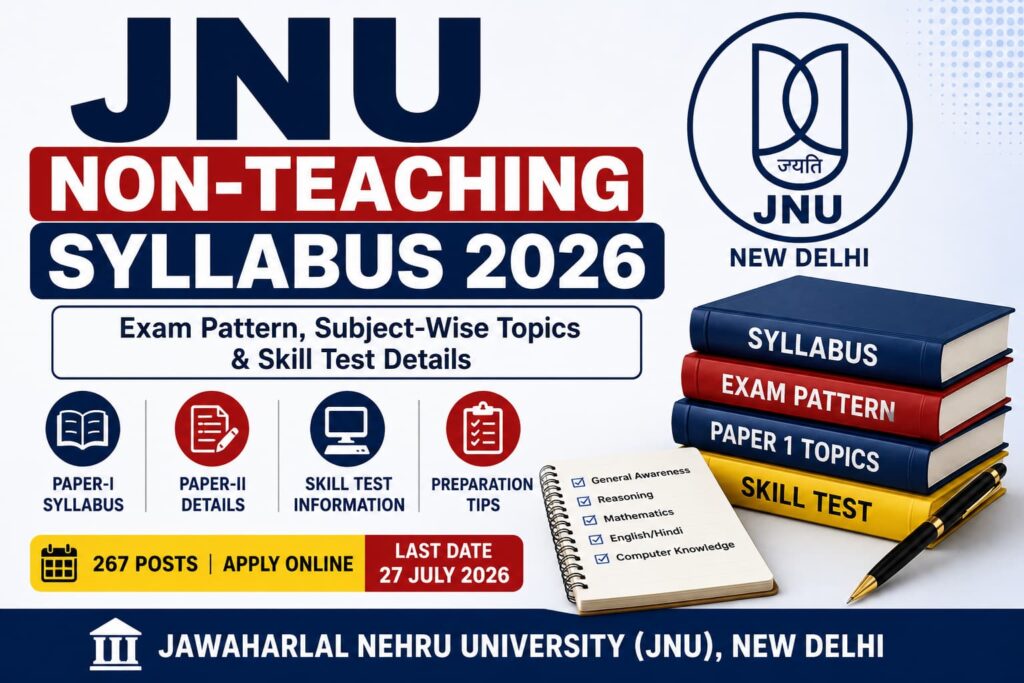
Jawaharlal Nehru University (JNU), New Delhi has released the JNU Non-Teaching Recruitment 2026 notification for 267 posts. Candidates applying for posts like Junior Assistant, Stenographer, MTS, Cook, Assistant, Personal Assistant, Senior Assistant, Works Assistant, Mess Helper and other non-teaching posts should understand the JNU Non-Teaching Syllabus 2026 and exam pattern properly before starting preparation.
The JNU non-teaching recruitment exam includes Paper-I for all posts, and for some posts there may also be Paper-II, skill test, trade test, or interview, depending on the nature of the post. The written test will check a candidate’s knowledge of General Awareness, Reasoning, Mathematics, Language, and Computer Knowledge. For some higher or technical posts, JNU may also conduct a subject-specific paper.
In this article, we have explained the JNU Non-Teaching Syllabus 2026, exam pattern, negative marking, minimum qualifying marks, skill test details, and post-wise preparation strategy in a simple format.
JNU Non-Teaching Syllabus 2026 Highlights
| Particulars | Details |
|---|---|
| Recruitment Name | JNU Non-Teaching Recruitment 2026 |
| University Name | Jawaharlal Nehru University (JNU) |
| Total Vacancies | 267 |
| Posts Covered | Junior Assistant, Stenographer, MTS, Cook, Assistant, Senior Assistant, PA, Works Assistant, Mess Helper and more |
| Exam Mode | Computer Based Test (CBT) / Written Exam |
| Written Exam Stages | Paper-I for all posts, Paper-II for some posts |
| Skill Test | Yes, for selected posts |
| Interview | Only for Group A posts |
| Negative Marking | Yes, 1/4 mark |
| Official Website | JNU Recruitment Portal |
JNU Non-Teaching Selection Process 2026
Before checking the syllabus, candidates should understand the selection process.
Selection Stages
Depending on the post, the selection process may include:
- Paper-I (CBT / Written Exam) – for all posts
- Paper-II – for some technical / higher posts
- Skill Test / Typing Test / Stenography Test / Trade Test – for specific posts
- Interview – only for Group A posts
- Document Verification
JNU Non-Teaching Exam Pattern 2026
Paper-I Exam Pattern
Paper-I is the common test for all candidates. It will test general aptitude, awareness, reasoning, language and computer knowledge.
| Subject | Number of Questions |
|---|---|
| General Awareness | 30 |
| Reasoning | 35 |
| Mathematics / Numerical Ability | 35 |
| Language (English / Hindi) | 30 |
| Computer Knowledge | 20 |
| Total | 150 Questions |
Paper-I Marking Scheme
| Particulars | Details |
|---|---|
| Total Questions | 150 |
| Total Marks | 300 |
| Duration | 2 Hours |
| Type of Questions | Objective Type / MCQ |
| Negative Marking | 1/4 mark deducted for each wrong answer |
Important Point
Since the exam has negative marking, candidates should avoid random guessing.
JNU Non-Teaching Paper-II Exam Pattern
Paper-II will be applicable for some specialised / technical / higher-level posts only.
| Particulars | Details |
|---|---|
| Total Questions | 50 |
| Total Marks | 100 |
| Type of Questions | Subject-Specific |
| Mode | CBT / Written |
| Purpose | To test post-related professional knowledge |
Who may face Paper-II?
Paper-II is more likely for posts such as:
- Assistant Registrar
- Assistant Librarian
- Research Officer
- System Analyst
- Executive Engineer
- Junior Engineer
- Professional Assistant
- Other technical / specialised posts
JNU Non-Teaching Syllabus 2026 – Subject Wise Topics
Now let’s understand the detailed subject-wise syllabus for Paper-I.
1) General Awareness Syllabus
This section checks how aware the candidate is about current events, India, and general knowledge.
Topics to Prepare
- Current Affairs (National and International)
- Indian History
- Indian Polity and Constitution
- Geography of India and World
- Indian Economy
- General Science
- Important Government Schemes
- Books and Authors
- Awards and Honours
- Sports News
- Important Days and Dates
- Famous Personalities
- Art and Culture
- Static GK
- Budget and Economic Survey basics
- Important Organisations and Headquarters
- Science and Technology updates
- University / Education related current affairs
Preparation Tip
Read daily current affairs, especially government schemes, education news, appointments, reports, and important national events.
2) Reasoning Syllabus
This section tests logical thinking, analytical ability, and pattern recognition.
Topics to Prepare
- Analogy
- Classification / Odd One Out
- Series (Number / Alphabet)
- Coding-Decoding
- Blood Relation
- Direction Sense
- Ranking and Order
- Syllogism
- Statement and Conclusion
- Seating Arrangement
- Puzzle
- Venn Diagram
- Calendar
- Clock
- Missing Number
- Mathematical Operations
- Input-Output (basic level if asked)
- Data Sufficiency
- Non-Verbal Reasoning
- Mirror Image / Water Image
- Figure Completion
Preparation Tip
Focus on speed + accuracy because reasoning questions can be solved quickly with practice.
3) Mathematics / Numerical Ability Syllabus
This section checks basic arithmetic, calculation ability and data interpretation.
Topics to Prepare
- Number System
- Simplification
- LCM and HCF
- Percentage
- Ratio and Proportion
- Average
- Profit and Loss
- Discount
- Simple Interest
- Compound Interest
- Time and Work
- Pipes and Cistern
- Time, Speed and Distance
- Boat and Stream
- Partnership
- Mixture and Allegation
- Mensuration
- Geometry basics
- Algebra basics
- Data Interpretation
- Tables and Graph-based questions
Preparation Tip
For Group C posts like Junior Assistant, MTS, Stenographer, Cook, Mess Helper, the maths level is usually basic to moderate. Strong command over percentage, ratio, average, profit-loss, and time-work is very useful.
4) Language Syllabus (English / Hindi)
This section tests language understanding, grammar, vocabulary and comprehension.
English Language Topics
- Reading Comprehension
- Fill in the Blanks
- Error Detection
- Sentence Improvement
- Synonyms and Antonyms
- One Word Substitution
- Idioms and Phrases
- Spelling Correction
- Sentence Rearrangement
- Cloze Test
- Active and Passive Voice
- Direct and Indirect Speech
- Vocabulary Usage
- Grammar Rules
Hindi Language Topics
- हिंदी व्याकरण
- वाक्य शुद्धि
- पर्यायवाची / विलोम शब्द
- मुहावरे और लोकोक्तियाँ
- गद्यांश / अपठित बोध
- रिक्त स्थान पूर्ति
- वाक्य विन्यास
- शब्द शुद्धि
- समास / संधि / उपसर्ग / प्रत्यय
- हिंदी शब्दावली
Preparation Tip
Candidates should prepare either English or Hindi language section carefully, depending on the exam format and comfort level.
5) Computer Knowledge Syllabus
This section is very important for posts like Junior Assistant, Assistant, Senior Assistant, Personal Assistant, Stenographer, Computer Operator and other office-related posts.
Topics to Prepare
- Basics of Computer
- History and Generations of Computer
- Input and Output Devices
- Hardware and Software
- Operating System
- MS Word
- MS Excel
- MS PowerPoint
- Internet and Email
- Keyboard Shortcuts
- Computer Memory
- Networking Basics
- Cyber Safety Basics
- File and Folder Management
- Basic Troubleshooting
- Use of Printers / Scanners / Office Devices
- Computer Abbreviations
- Online Office Work Basics
Preparation Tip
Candidates should especially prepare MS Office, typing environment, email, internet basics and office computer usage, because these are very relevant for university non-teaching jobs.
JNU Non-Teaching Skill Test 2026
Some posts will have skill test / practical test / trade test after the written exam. These tests are usually qualifying in nature, but candidates must prepare for them seriously.
1) Junior Assistant Skill Test
Candidates applying for Junior Assistant may have to appear in a typing test / computer proficiency test.
Likely Skill Areas
- English typing speed
- Hindi typing speed (if applicable)
- Basic computer operation
- MS Word / MS Excel usage
- File handling / office work basics
2) Stenographer Skill Test
Candidates applying for Stenographer will likely face a stenography skill test.
Likely Skill Areas
- Dictation
- Transcription
- English / Hindi stenography
- Typing speed
- Office communication formatting
3) Personal Assistant / Private Secretary Skill Test
Candidates applying for PA / Private Secretary posts should prepare for:
- Shorthand / stenography
- Typing speed
- Drafting / office communication
- Computer proficiency
4) Assistant / Senior Assistant Skill Test
Candidates applying for Assistant / Senior Assistant should prepare for:
- Typing
- Computer proficiency
- Office file handling
- Noting and drafting basics
- MS Office knowledge
5) Works Assistant / Engineering Attendant / Khalasi / Cook / Mess Helper / MTS
For these posts, JNU may conduct a trade test / practical test / skill test depending on post requirements.
Example Areas
- Basic practical knowledge of work assigned
- Kitchen / mess work understanding for Cook / Mess Helper
- Maintenance / field work basics for Works Assistant / Engineering Attendant
- General support staff duties for MTS / Office Attendant
JNU Non-Teaching Interview 2026
Interview is only for Group A posts.
Group A Final Weightage
| Stage | Weightage |
|---|---|
| Written Exam | 70% |
| Interview | 30% |
Group A Posts May Include
- Assistant Registrar
- Assistant Librarian
- Research Officer
- Executive Engineer
- System Analyst
- Curator
- Public Relation Officer
Minimum Qualifying Marks
JNU has prescribed minimum qualifying marks for the written examination.
| Category | Minimum Qualifying Marks |
|---|---|
| General / EWS | 40% |
| OBC / SC / ST / PwD | 35% |
Post-Wise Preparation Strategy
Since JNU Non-Teaching Recruitment 2026 includes many different posts, candidates should prepare according to their post category.
Preparation Strategy for Junior Assistant / Assistant / Senior Assistant
Focus more on:
- Reasoning
- Mathematics
- English / Hindi grammar
- Computer knowledge
- Typing practice
Best Approach
- Practice daily typing
- Revise MS Office
- Solve previous assistant-level recruitment papers
- Improve speed in arithmetic and reasoning
Preparation Strategy for Stenographer / PA / Private Secretary
Focus more on:
- Stenography practice
- Typing speed
- Language section
- Computer basics
- Office communication format
Best Approach
- Daily shorthand practice
- Dictation + transcription practice
- Improve typing accuracy
- Revise grammar and office terms
Preparation Strategy for MTS / Mess Helper / Cook / Office Attendant
Focus more on:
- Basic GK
- Basic reasoning
- Simple maths
- Daily life science / general awareness
- Work-related practical knowledge
Best Approach
- Prepare basic arithmetic
- Read current affairs notes
- Solve Group C level practice questions
- Understand practical job duties
Preparation Strategy for Technical / Higher Posts
Posts like System Analyst, Executive Engineer, Research Officer, Assistant Librarian, Junior Engineer, Professional Assistant may require Paper-II / technical knowledge.
Best Approach
- Prepare Paper-I first
- Then study the core subject / professional syllabus
- Read job profile and essential qualification carefully
- Focus on technical concepts related to the post
Best Books for JNU Non-Teaching Preparation
For General Awareness
- Lucent General Knowledge
- Monthly Current Affairs Magazine
- Daily current affairs notes
For Reasoning
- R.S. Aggarwal Reasoning
- Kiran reasoning practice book
For Mathematics
- R.S. Aggarwal Quantitative Aptitude
- Fast Track Arithmetic
For English
- Objective General English by S.P. Bakshi
- Plinth to Paramount (for grammar improvement)
For Computer
- Arihant Computer Awareness
- Basic Computer Notes + MCQ practice
For Hindi
- Samanya Hindi practice book
- Previous Hindi grammar MCQs
Important Preparation Tips for JNU Non-Teaching Exam 2026
- Understand your post first – especially whether it includes only Paper-I or Paper-II / skill test also.
- Do not ignore computer knowledge – it is important for many JNU posts.
- Practice mock tests – because the exam has negative marking.
- Revise current affairs daily – especially national events, education and government schemes.
- Practice typing / shorthand if you are applying for Junior Assistant, Stenographer, PA or Assistant posts.
- Prepare basic maths and reasoning daily for speed.
- Keep separate notes for Paper-I and post-specific Paper-II topics.
- Read the official post details carefully because trade tests may vary by post.
Important FAQs – JNU Non-Teaching Syllabus 2026
1. What is the syllabus of JNU Non-Teaching Recruitment 2026?
The Paper-I syllabus includes General Awareness, Reasoning, Mathematics, English/Hindi Language and Computer Knowledge. Some posts may also have Paper-II, skill test or interview.
2. Is there negative marking in JNU Non-Teaching Exam 2026?
Yes, 1/4 mark will be deducted for each wrong answer.
3. How many questions will be asked in JNU Non-Teaching Paper-I?
Paper-I will have 150 questions for 300 marks.
4. Is there a separate syllabus for Junior Assistant in JNU?
Junior Assistant candidates should prepare the common Paper-I syllabus and also practice typing / computer proficiency for the skill test.
5. Is there an interview in JNU Non-Teaching Recruitment 2026?
Interview is only for Group A posts. Group B and Group C posts generally do not have interview.
6. What are the subjects in JNU Non-Teaching Paper-I?
The subjects are:
- General Awareness
- Reasoning
- Mathematics
- English / Hindi Language
- Computer Knowledge
7. Will JNU conduct Paper-II for all posts?
No, Paper-II is likely only for selected technical / specialised / higher-level posts.
8. What is the minimum qualifying mark in JNU Non-Teaching exam?
- General / EWS: 40%
- OBC / SC / ST / PwD: 35%
9. Is skill test compulsory in JNU Non-Teaching Recruitment?
Yes, for some posts like Junior Assistant, Stenographer, PA, Private Secretary, Assistant and certain practical/trade posts, skill test may be conducted.
10. What is the best way to prepare for JNU Non-Teaching 2026?
Prepare Paper-I subjects daily, solve mock tests, revise current affairs, and practice typing / shorthand / trade skills depending on your post.
Conclusion
The JNU Non-Teaching Syllabus 2026 is very important for candidates preparing for Junior Assistant, Stenographer, MTS, Cook, Assistant, PA, Senior Assistant, Works Assistant and other posts. The exam mainly tests general aptitude, awareness, maths, language and computer knowledge, while some posts also require Paper-II, skill test or interview. Candidates should start preparation early and focus on both written exam strategy and post-specific skill requirements.