
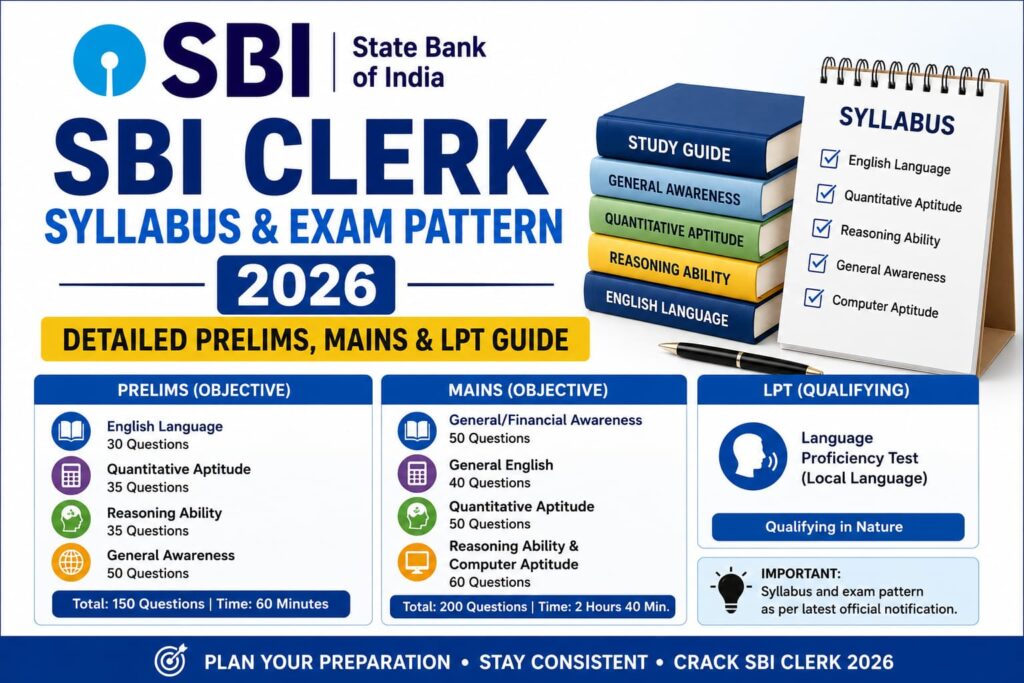
Understanding the SBI Clerk Syllabus and Exam Pattern is the most crucial step for any aspirant aiming to crack the State Bank of India (SBI) Junior Associate Recruitment 2026. With 9,766 vacancies announced for Customer Support & Sales, competition is high, making a structured study plan mandatory.
To help you prepare effectively, this comprehensive guide provides a complete, section-wise breakdown of the SBI Clerk Prelims and Mains Syllabus 2026, detailed exam pattern tables, high-weightage topics, marking schemes, negative marking rules, and the Local Language Proficiency Test (LPT) requirements.
SBI Clerk Selection Process 2026: Overview
The recruitment of Junior Associates in the State Bank of India consists of three distinct stages:
- Phase 1: Preliminary Examination (Online Objective Test) – Qualifying in nature.
- Phase 2: Main Examination (Online Objective Test) – Marks count for the final merit list.
- Phase 3: Local Language Proficiency Test (LPT) – Qualifying stage (where applicable).
Important Note: There is NO interview round for the SBI Clerk / Junior Associate post. Final selection is strictly based on the aggregate marks scored in the Main Examination, subject to clearing the LPT and Document Verification.
SBI Clerk Prelims Exam Pattern 2026
The Preliminary Examination is an online objective test designed to test your speed, accuracy, and basic conceptual clarity. It comprises 100 questions for a total of 100 marks with a time duration of 60 minutes.
Prelims Exam Structure Table
| Section | Medium of Exam | No. of Questions | Max Marks | Sectional Timing |
| English Language | English | 30 | 30 | 20 Minutes |
| Numerical Ability | English & Local Language | 35 | 35 | 20 Minutes |
| Reasoning Ability | English & Local Language | 35 | 35 | 20 Minutes |
| Total | 100 | 100 | 60 Minutes (1 Hour) |
Key Rules for Prelims Exam:
- Negative Marking: $\frac{1}{4}\text{th}$ mark (0.25 marks) is deducted for each incorrect response.
- Sectional Timing: Each section has a fixed time limit of 20 minutes. You cannot switch between sections.
- Sectional Cut-offs: SBI does NOT prescribe sectional cut-offs for the Prelims exam. Candidates are shortlisted for Mains based on the overall aggregate score (approximately 10 times the state/category-wise vacancies).
SBI Clerk Mains Exam Pattern 2026
The Main Examination tests advanced problem-solving, financial literacy, and speed across 190 questions carrying 200 marks with a total duration of 2 Hours 40 Minutes (160 Minutes).
Mains Exam Structure Table
| Section | Medium of Exam | No. of Questions | Max Marks | Sectional Timing |
| General / Financial Awareness | English & Regional | 50 | 50 | 35 Minutes |
| General English | English | 40 | 40 | 35 Minutes |
| Quantitative Aptitude | English & Regional | 50 | 50 | 45 Minutes |
| Reasoning Ability & Computer Aptitude | English & Regional | 50 | 60 | 45 Minutes |
| Total | 190 | 200 | 160 Minutes |
Key Rules for Mains Exam:
- Negative Marking: 0.25 marks deducted per wrong answer.
- No Sectional Cut-offs: Aggregate score determines qualification.
- Merit List: Final state-wise and category-wise merit list is prepared strictly based on aggregate marks secured in the Mains Examination.
Detailed Subject-Wise Syllabus for SBI Clerk 2026
1. Reasoning Ability Syllabus (Prelims & Mains)
Reasoning evaluates your logical thinking, spatial awareness, and analytical aptitude.
- Puzzles & Seating Arrangements: Linear, Circular, Square, Rectangular, Parallel Rows, Floor-based, Box-based, Scheduling (Month/Day), Designation, and Uncertain Number Arrangements.
- Syllogism: Standard, Possibility cases, Only/Few cases, and Reverse Syllogisms.
- Inequality: Direct Statements, Coded Inequality, and Coded Comparisons.
- Coding-Decoding: Traditional, Conditional, Substitution, and New-pattern Matrix Coding.
- Alphanumeric & Letter Series: Number-Symbol-Letter sequences and position-based pattern problems.
- Blood Relations: Family Tree, Generation-based, and Coded Relationships.
- Direction & Distance: Coordinates, turns, and shortest distance calculations.
- Input-Output: Word, Number, Symbol, and Step-based rearrangement problems.
- Critical Reasoning (Mains focus): Statement & Assumptions, Statement & Conclusions, Cause & Effect, Course of Action, and Strong/Weak Arguments.
- Data Sufficiency: Statement-based logical sufficiency questions.
2. Quantitative Aptitude / Numerical Ability Syllabus
This section measures your speed, numerical accuracy, and mathematical ability.
- Simplification & Approximation: Order of operations, fractions, surds, indices, and mental calculation tricks.
- Number Series: Missing and Wrong Number Series patterns.
- Quadratic Equations: Inequality comparison between $x$ and $y$ roots.
- Data Interpretation (DI): Tables, Bar Graphs, Line Graphs, Pie Charts, Radar Charts, Missing DI, and Caselet DI.
- Arithmetic Concepts:
- Percentages, Ratio & Proportion, Averages, Ages
- Profit, Loss, and Discount
- Simple Interest & Compound Interest
- Time & Work, Pipes & Cisterns
- Time, Speed & Distance, Trains, Boats & Streams
- Mixtures & Alligations
- Partnership, Permutations & Combinations, Probability
- Mensuration (2D & 3D Area, Volume)
- Quantity Comparison & Data Sufficiency (Mains): Comparing Quantity I vs Quantity II.
3. General English Syllabus
Designed to evaluate language proficiency, vocabulary, and reading comprehension capabilities.
- Reading Comprehension (RC): Fact-based, inference-based, central idea, tone, vocabulary in context, and title-based questions.
- Cloze Test: Passage filling using contextual vocabulary and grammar rules.
- Error Detection & Sentence Correction: Subject-verb agreement, tenses, prepositions, articles, pronouns, and conjunctions.
- Para Jumbles & Sentence Rearrangement: Reordering sentences into a meaningful paragraph.
- Vocabulary & Word Usage: Synonyms, Antonyms, Homonyms, Word Swap, Phrase Replacement, and Single/Double Fillers.
4. General & Financial Awareness Syllabus (Mains Only)
This section is high-scoring and requires regular daily preparation.
- Current Affairs: National and International news, summits, conferences, sports, awards, books & authors, latest appointments, and MoUs signed in the last 6 months.
- Banking & Financial Awareness:
- Functions of RBI, Monetary Policy rates, Inflation, Repo/Reverse Repo Rates
- Capital Adequacy, Basel Norms, Priority Sector Lending (PSL), NPA management
- Deposit Insurance, Payment Banks, Small Finance Banks, Digital Banking & UPI
- Financial inclusion, Insurance, Pension schemes, and Union Budget details
- Government Schemes: Central and State welfare, agriculture, and employment schemes.
- Static General Knowledge: National Parks, Wildlife Sanctuaries, Dams, Thermal Power Plants, Airports, Capitals, Currencies, and Important Days.
5. Computer Aptitude Syllabus (Mains Only)
Integrated with Reasoning Ability in the Mains examination:
- Basics of Computers: Hardware, Software, Generations, and Architecture.
- Operating Systems & MS Office: MS Word, MS Excel, MS PowerPoint shortcuts and commands.
- Internet & Networking: OSI Model, IP Addressing, Protocols, Cyber Security, Viruses, and Firewalls.
- Data Representation & Logic Gates: Binary to Decimal Conversions, Number System transformations, and Flowcharts.
High-Weightage Topics Comparison
| Subject | Prelims High-Weightage Topics | Mains High-Weightage Topics |
| Reasoning Ability | Puzzles & Seating (15-20 Qs), Syllogism, Inequality, Alphanumeric Series | Advanced Puzzles, Machine Input-Output, Critical Reasoning, Coded Statements |
| Quantitative Aptitude | Simplification/Approximation (10-15 Qs), Number Series, Quadratic, DI Sets | Caselet DI, Missing DI, Data Sufficiency, Quantity I & II, Arithmetic |
| English Language | Reading Comprehension (8-10 Qs), Error Spotting, Cloze Test, Fillers | Advanced RC, Sentence Rearrangement, Phrase Replacement, Vocabulary |
| General Awareness | N/A (Not in Prelims) | Banking Current Affairs, RBI Policies, Government Schemes, Static GK |
Local Language Proficiency Test (LPT)
Candidates who qualify for the Mains examination will be required to undergo a Local Language Proficiency Test (LPT) before joining:
- Exemption Rule: Candidates who have studied the specified local language as a subject in their Class 10th or 12th standard (as evidenced by mark sheets/certificates) are exempted from taking the LPT.
- Testing Format: For others, LPT evaluates reading, writing, speaking, and understanding skills in the official local language of the state applied for.
- Nature: LPT is qualifying in nature. Failure to pass the LPT will lead to disqualification.
Recommended Books & Study Material
- Quantitative Aptitude: Quantitative Aptitude for Competitive Examinations by R.S. Aggarwal / Fast Track Objective Arithmetic by Rajesh Verma.
- Reasoning Ability: A Modern Approach to Verbal & Non-Verbal Reasoning by R.S. Aggarwal / A Complete Book on Puzzles & Seating Arrangements.
- English Language: Objective General English by S.P. Bakshi / Word Power Made Easy by Norman Lewis.
- Banking & Financial Awareness: Banking Awareness by Arihant / Disha Publications.
Frequently Asked Questions (FAQs)
Q1. Is there a negative marking in the SBI Clerk exam?
Yes, both the Prelims and Mains exams have a negative marking of 0.25 marks ($\frac{1}{4}\text{th}$ mark) for every wrong answer.
Q2. Does SBI Clerk have sectional cut-offs?
No, State Bank of India does not prescribe sectional cut-offs for either the Prelims or Mains exam. Selection is based purely on the overall aggregate score.
Q3. Are Prelims marks added to the final merit list?
No, the Preliminary Exam is purely qualifying in nature. The final merit list is prepared solely based on the marks secured in the Main Examination.
Q4. What is the syllabus for the Computer Aptitude section?
Computer Aptitude includes questions on basic computer hardware/software, MS Office shortcuts, networking concepts, logic gates, binary system conversions, and cybersecurity fundamentals.
For real-time updates on SBI Clerk Admit Cards, Exam Dates, Results, and Cut-off marks, keep visiting sarkarijobsforyou.com!