
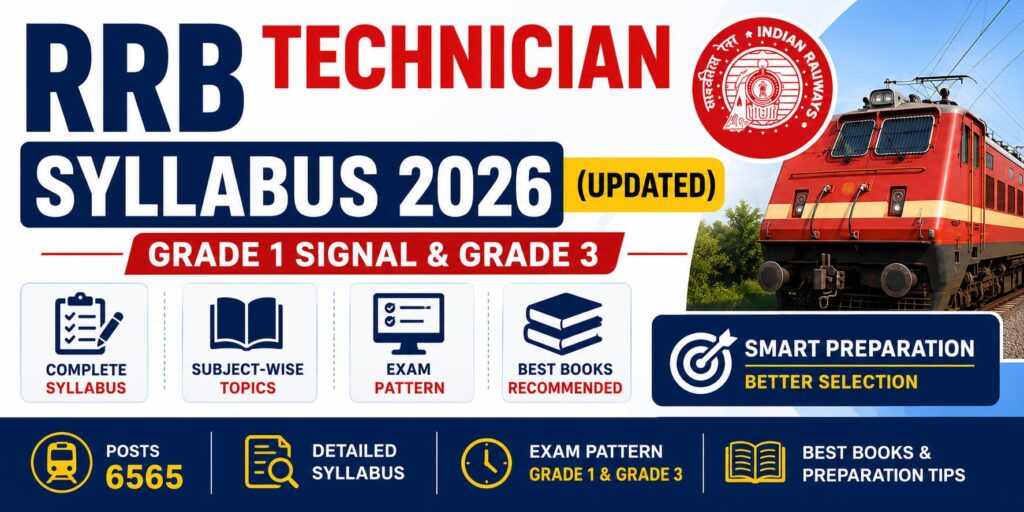
If you are preparing for the RRB Technician Recruitment 2026 (CEN 02/2026), then understanding the complete syllabus is the very first step to cracking the exam. The Railway Recruitment Board has officially released the RRB Technician Syllabus 2026 for Technician Grade-I Signal and Technician Grade-III posts along with the CEN 02/2026 notification.
The syllabus for Grade-I and Grade-III is different. Grade-I Signal has 5 subjects including Basic Science & Engineering and Computer Applications, while Grade-III has 4 subjects focusing more on General Science. Both exams have 100 questions for 100 marks in 90 minutes with 1/3rd negative marking.
This page gives you the complete updated RRB Technician Syllabus 2026, subject-wise important topics, exam pattern, minimum qualifying marks, and the best books recommended by toppers for each subject. Read this page carefully and start your preparation the smart way.
RRB Technician Syllabus 2026 – Quick Overview
| Particulars | Details |
|---|---|
| Exam Name | RRB Technician CBT 2026 |
| Notification Number | CEN 02/2026 |
| Posts | Technician Grade-I Signal & Technician Grade-III |
| Total Questions | 100 |
| Total Marks | 100 |
| Exam Duration | 90 Minutes |
| Negative Marking | Yes – 1/3rd mark per wrong answer |
| Question Type | Objective (MCQ) |
| Medium | Hindi and English |
| Syllabus Level | Class 10 / ITI / Diploma level |
| Official Website | www.rrbapply.gov.in |
Key Difference: Grade-I Signal vs Grade-III Syllabus
Before going into the detailed syllabus, understand this important difference:
| Feature | Grade-I Signal | Grade-III |
|---|---|---|
| Number of Subjects | 5 | 4 |
| Unique Subject | Basic Science & Engineering (35 marks) | General Science (40 marks) |
| Computer Section | Yes – Basics of Computers (20 marks) | No |
| Highest Scoring Section | Basic Science & Engineering | General Science |
| Difficulty Level | Higher (Diploma/Degree level) | Moderate (Class 10 / ITI level) |
Simple Rule: If you are applying for Grade-I Signal, study 5 subjects with more focus on engineering basics and computers. If you are applying for Grade-III, study 4 subjects with maximum focus on General Science.
RRB Technician Grade-I Signal – Exam Pattern 2026
| Subject | Number of Questions | Total Marks |
|---|---|---|
| General Awareness | 10 | 10 |
| General Intelligence & Reasoning | 15 | 15 |
| Basics of Computers & Applications | 20 | 20 |
| Mathematics | 20 | 20 |
| Basic Science & Engineering | 35 | 35 |
| Total | 100 | 100 |
- Duration: 90 Minutes (120 minutes for eligible PwBD candidates)
- Negative Marking: 1/3rd mark deducted per wrong answer
- No deduction for unattempted questions
- Mode: Online Computer Based Test (CBT)
RRB Technician Grade-III – Exam Pattern 2026
| Subject | Number of Questions | Total Marks |
|---|---|---|
| Mathematics | 25 | 25 |
| General Intelligence & Reasoning | 25 | 25 |
| General Science | 40 | 40 |
| General Awareness | 10 | 10 |
| Total | 100 | 100 |
- Duration: 90 Minutes
- Negative Marking: 1/3rd mark deducted per wrong answer
- Mode: Online Computer Based Test (CBT)
Minimum Qualifying Marks – RRB Technician CBT 2026
You must score at least this much in the CBT to be shortlisted:
| Category | Minimum Qualifying Percentage |
|---|---|
| UR (General) & EWS | 40% (40 marks out of 100) |
| OBC (Non-Creamy Layer) | 30% (30 marks out of 100) |
| SC | 30% (30 marks out of 100) |
| ST | 25% (25 marks out of 100) |
| PwBD Candidates | 2% relaxation additionally applicable |
RRB Technician Syllabus 2026 – Subject-wise Detailed Topics
Now let us go through each subject in detail for both Grade-I and Grade-III.
1. Mathematics (Grade-I: 20 Marks | Grade-III: 25 Marks)
Mathematics is common to both Grade-I and Grade-III. The difficulty level is up to Class 10th standard (CBSE/NCERT). Here are all the important topics:
| Topic | What to Study |
|---|---|
| Number System | Natural numbers, integers, rational numbers, HCF, LCM |
| BODMAS | Order of operations, bracket simplification |
| Decimals & Fractions | Conversion, operations, comparisons |
| LCM & HCF | Finding LCM/HCF by prime factorisation and division method |
| Ratio & Proportion | Direct proportion, inverse proportion, fourth proportional |
| Percentages | Calculation, percentage change, profit and loss using percentage |
| Mensuration | Area and perimeter of square, rectangle, triangle, circle; Volume of cube, cuboid, cylinder |
| Time & Work | Work done, pipes & cisterns, combined efficiency |
| Time & Distance | Speed, average speed, relative speed, trains, boats |
| Simple Interest | SI formula, finding principal/rate/time |
| Compound Interest | CI formula, difference between SI and CI |
| Profit & Loss | Cost price, selling price, discount, marked price |
| Algebra | Linear equations, basic algebraic identities |
| Geometry | Lines, angles, triangles, quadrilaterals, circles, congruence, similarity |
| Trigonometry | Sin, cos, tan values for standard angles, basic identities |
| Elementary Statistics | Mean, median, mode, range, bar chart, pie chart |
| Square Root & Cube Root | Finding roots by factorisation |
| Age Calculations | Age-based problems and equations |
| Calendar & Clock | Days, dates, clock angles |
| Pipes & Cistern | Filling and emptying problems |
Tips for Maths: Practise at least 20 questions daily. Focus on Time & Work, Percentage, and Ratio & Proportion — these appear most frequently in RRB exams.
2. General Intelligence & Reasoning (Grade-I: 15 Marks | Grade-III: 25 Marks)
Reasoning tests your logical thinking, pattern recognition, and problem-solving ability. It is the same for both grades. Topics:
| Topic | What to Study |
|---|---|
| Analogies | Word analogies, number analogies, letter analogies |
| Alphabetical Series | Letter patterns, missing letters |
| Number Series | Missing number, wrong number in series |
| Coding & Decoding | Letter coding, number coding, substitution |
| Mathematical Operations | Symbols used for +, -, ×, ÷ type questions |
| Relationships | Blood relations, family tree questions |
| Syllogism | All/Some/No type statements and conclusions |
| Jumbling | Rearranging letters or numbers in a pattern |
| Venn Diagram | Relationship between sets, finding members |
| Data Interpretation | Tables, bar graphs, line graphs, pie charts |
| Conclusions & Decision Making | Drawing logical conclusions from given statements |
| Similarities & Differences | Odd one out, matching pairs |
| Analytical Reasoning | Seating arrangement, ranking, scheduling |
| Classification | Category-based grouping |
| Directions | Map-based distance/direction problems |
| Statement – Arguments | Strong/weak arguments type questions |
| Statement – Assumptions | Implicit assumptions type questions |
Tips for Reasoning: Reasoning is the most scoring section if practised regularly. Solve at least 15–20 reasoning questions every day. Focus on series, coding-decoding, and blood relations — these come most frequently.
3. General Science (Grade-III Only: 40 Marks)
General Science is the most important and highest-scoring section for Grade-III. It covers Physics, Chemistry, and Life Sciences (Biology) up to Class 10th NCERT/CBSE level.
Physics Topics
- Motion — distance, displacement, speed, velocity, acceleration
- Force and Newton’s Laws of Motion
- Work, Power, and Energy
- Light — reflection, refraction, lenses, mirrors
- Sound — propagation, reflection, echo
- Heat — temperature, thermal expansion, specific heat
- Electricity — Ohm’s law, resistance, circuits, power
- Magnetism — magnetic field, electromagnets
- Gravitation — laws of gravitation, weight, free fall
- Simple Machines — lever, pulley, inclined plane
Chemistry Topics
- Matter and Its States — solid, liquid, gas
- Atoms and Molecules — atomic mass, molecular mass
- Chemical Reactions and Equations — types of reactions
- Acids, Bases, and Salts — pH scale, uses
- Metals and Non-Metals — properties, reactivity series
- Carbon and Its Compounds — hydrocarbons, functional groups
- Periodic Table — groups and periods, trends
- Fuel and Combustion
- Common Chemical Substances and their uses
Biology Topics
- Cell — structure, function, cell division
- Human Body Systems — digestive, respiratory, circulatory, nervous, excretory
- Nutrition — types, balanced diet, deficiency diseases
- Reproduction — asexual, sexual, human reproduction
- Microorganisms — bacteria, viruses, fungi, their uses and diseases
- Heredity and Evolution — Mendel’s laws, Darwin’s theory
- Natural Resources — water, air, soil, their conservation
- Ecosystems — food chain, food web, biodiversity
- Diseases — communicable, non-communicable, prevention
Tips for General Science: Use NCERT Science textbooks Class 6 to Class 10. This section carries 40 marks — do not ignore it. Biology is often the easiest part and should be covered fully.
4. Basic Science & Engineering (Grade-I Signal Only: 35 Marks)
This is the highest-scoring and most important section for Grade-I Signal (35 out of 100 marks). It tests fundamental engineering and science concepts at ITI/Diploma level.
| Topic | What to Study |
|---|---|
| Engineering Drawing | Projections (First angle, Third angle), Orthographic views, Cross sections, Lines and their types, Drawing instruments and their use, Geometric figures, Symbolic representation of electrical/electronic components |
| Units & Measurements | SI units, CGS units, fundamental and derived units, measurement tools |
| Mass, Weight & Density | Definitions, difference between mass and weight, density of common materials |
| Work, Power & Energy | Formulae, types of energy, conservation of energy |
| Speed & Velocity | Definitions, equations of motion, acceleration |
| Heat & Temperature | Scales of temperature (Celsius, Fahrenheit, Kelvin), heat transfer methods (conduction, convection, radiation) |
| Basic Electricity | Ohm’s Law, Kirchhoff’s Laws, resistance in series and parallel, AC and DC current, voltage, power (P=VI), basic circuit diagrams |
| Levers & Simple Machines | Types of levers, mechanical advantage, pulleys, wheel and axle, inclined plane |
| Occupational Safety & Health | Workplace safety rules, personal protective equipment (PPE), first aid basics, fire safety |
| Environment Education | Pollution types (air, water, soil, noise), waste management, conservation of resources, renewable energy basics |
| IT Literacy | Basic computer operations, input/output devices, types of software, internet basics, email basics, cybersecurity awareness |
Tips for BSE: This section has the most marks. Go topic by topic — do not try to study it all at once. Electricity and Engineering Drawing questions appear most frequently. Buy a dedicated ITI/Diploma-level reference book for this section.
5. Basics of Computers & Applications (Grade-I Signal Only: 20 Marks)
This section tests basic computer knowledge. Topics:
| Topic | What to Study |
|---|---|
| Computer Organisation | CPU (ALU, CU, Memory), input/output devices, storage devices (HDD, SSD, Pen Drive) |
| Operating Systems | Windows, Linux, UNIX — basic navigation, files, folders |
| MS Office | MS Word (basic formatting), MS Excel (basic formulas), MS PowerPoint (slides) |
| Internet & Web Basics | Browser, URL, HTTP/HTTPS, search engines, downloading, bookmarks |
| Computer Networking | LAN, WAN, MAN, Wi-Fi, IP address basics, types of networks |
| Cyber Security | Viruses, malware, antivirus, password security, phishing awareness |
| Number Systems | Binary, Decimal, Hexadecimal conversion |
| Software Types | System software, application software, utility software |
| Email & Communication | Basic email operations, attachments |
| Data Storage Units | Bit, Byte, KB, MB, GB, TB |
Tips for Computers: This is one of the easiest sections to score full marks in. Study basic computer concepts and MS Office operations. Take a few mock tests specifically for computers to check your level.
6. General Awareness & Current Affairs (Grade-I: 10 Marks | Grade-III: 10 Marks)
General Awareness is common to both grades and carries 10 marks. Topics:
| Topic | What to Study |
|---|---|
| Current Affairs | National and international news from last 6 months |
| Indian Railways | Latest news, new train launches, railway budget, key appointments |
| Science & Technology | New discoveries, space missions (ISRO), technology updates |
| Sports | Major tournament results, sports personalities, India’s medals |
| Indian History | Important dates, movements, major events |
| Indian Geography | Rivers, mountains, states, capitals, national parks |
| Indian Constitution & Polity | Fundamental rights, government structure, important articles |
| Economy | GDP, inflation, budget highlights, important govt schemes |
| Indian Culture | Festivals, art forms, UNESCO heritage sites |
| Awards & Recognitions | Bharat Ratna, Padma awards, Nobel Prize winners |
| Important Personalities | Key appointments in government, sports heroes, scientists |
Tips for GA: Read a good newspaper or download a monthly current affairs PDF. Focus on the last 4–6 months before your exam. Indian Railways news is especially important — read about new trains, projects, and appointments in railways.
RRB Technician Syllabus 2026 – At a Glance Summary Table
| Subject | Grade-I Marks | Grade-III Marks | Level |
|---|---|---|---|
| Mathematics | 20 | 25 | Class 10 |
| General Intelligence & Reasoning | 15 | 25 | Class 10 |
| General Science | — | 40 | Class 10 (NCERT) |
| General Awareness | 10 | 10 | Current Events |
| Basic Science & Engineering | 35 | — | ITI/Diploma |
| Basics of Computers | 20 | — | Basic IT Knowledge |
| Total | 100 | 100 |
RRB Technician 2026 – Best Books for Preparation
Choosing the right books is as important as hard work. Below are the best books recommended by toppers and experts for each subject. These are widely available in book stores and online.
Mathematics
| Book | Author / Publisher | Why It’s Good |
|---|---|---|
| Quantitative Aptitude for Competitive Exams | R.S. Aggarwal (S. Chand) | Best book for all maths topics; covers every chapter with exercises |
| Fast Track Objective Arithmetic | Rajesh Verma (Arihant) | Great for quick revision and shortcut methods |
| NCERT Mathematics Textbooks Class 9 & 10 | NCERT | Best for building basics — free on ncert.nic.in |
| Kiran’s Railway Mathematics | Kiran Prakashan | Especially made for railway exams with previous year questions |
Top Pick for Maths: R.S. Aggarwal’s Quantitative Aptitude is the gold standard for competitive exam maths. Buy this first.
General Intelligence & Reasoning
| Book | Author / Publisher | Why It’s Good |
|---|---|---|
| A Modern Approach to Verbal & Non-Verbal Reasoning | R.S. Aggarwal (S. Chand) | The most comprehensive reasoning book available — covers all topics |
| Analytical Reasoning | M.K. Pandey (BSC Publishing) | Excellent for statement-argument, assumption, and puzzle type questions |
| Kiran’s Reasoning | Kiran Prakashan | Railway-specific reasoning with past paper questions |
Top Pick for Reasoning: R.S. Aggarwal’s Reasoning book is a must-have. It covers both verbal and non-verbal reasoning in one book.
General Science (Grade-III)
| Book | Author / Publisher | Why It’s Good |
|---|---|---|
| NCERT Science Class 6, 7, 8, 9, 10 | NCERT | Best base material — free to download at ncert.nic.in |
| Lucent’s General Science | Lucent Publication | Covers Physics, Chemistry, Biology in a compact format with MCQs |
| General Science by P.S. Verma | Laxmi Publications | Very popular for Biology section; easy language |
| Arihant General Science | Arihant Publications | Railway and SSC specific science book with practice questions |
Top Pick for General Science: Start with NCERT Class 9 and 10. Then use Lucent’s General Science for quick revision before the exam.
Basic Science & Engineering (Grade-I Signal)
| Book | Author / Publisher | Why It’s Good |
|---|---|---|
| Basic Science & Engineering for RRB | Arihant Publications | Specifically made for RRB exams covering all BSE topics |
| Basic Science & Engineering (Railway) | Kiran Prakashan | Railway-focused BSE book with chapter tests |
| Engineering Drawing | ND Bhatt (Charotar Publishing) | Best for Engineering Drawing projections and views |
| Basic Electrical Engineering | V.K. Mehta (S. Chand) | Ideal for Basic Electricity chapter — very clear explanations |
| NCERT Physics Class 9 & 10 | NCERT | For fundamentals of physics like motion, force, energy |
Top Pick for BSE: The Arihant RRB Basic Science & Engineering book is the best single book for this section. Pair it with NCERT Physics for the theory.
Basics of Computers & Applications (Grade-I Signal)
| Book | Author / Publisher | Why It’s Good |
|---|---|---|
| Computer Awareness | Arihant Publications | Covers all computer topics in a simple and structured way |
| Objective Computer Awareness | R. Pillai (Kiran Prakashan) | MCQ-based practice for competitive exams |
| Lucent’s Computer | Lucent Publication | Compact and easy-to-revise computer book |
Top Pick for Computers: Lucent’s Computer is short and easy to finish. Use it for quick revision. For more practice, use Arihant’s Computer Awareness.
General Awareness & Current Affairs
| Book | Author / Publisher | Why It’s Good |
|---|---|---|
| Lucent’s General Knowledge | Lucent Publication | The most popular GK book in India — covers all static GK topics |
| Manorama Yearbook 2026 | Manorama Publications | Best for current affairs and GK facts of the year |
| Monthly Current Affairs PDF | sarkarijobsforyou.com / Bankersadda / Adda247 | Free monthly capsules available online — easy to read on phone |
| Pratiyogita Darpan | Pratiyogita Darpan Publication | Monthly magazine covering current affairs and GK topics |
Top Pick for GA: Use Lucent’s GK for static knowledge + any free monthly current affairs PDF for recent events. Do not spend money on multiple GA books.
All-in-One / Complete Guide Books
If you want one single book that covers all subjects for RRB Technician, here are the best options:
| Book | Author / Publisher | Best For |
|---|---|---|
| RRB Technician Grade I Signal Complete Guide | Arihant Publications | Best all-in-one book for Grade-I Signal — covers all 5 subjects |
| RRB Technician Grade III Complete Guide | Arihant Publications | Best all-in-one book for Grade-III — covers all 4 subjects |
| Kiran RRB Technician Chapter-wise Solved Papers | Kiran Prakashan | Previous year questions sorted by chapter — best for revision |
| RRB Technician Guide | Youth Competition Times (YCT) | Budget-friendly option covering full syllabus with practice sets |
Top Pick Overall: The Arihant RRB Technician Complete Guide (for your grade) is the best single book to start with. Add Kiran’s Solved Papers for previous year practice.
Online Resources (Free)
Apart from books, use these free online resources:
| Resource | What You Get |
|---|---|
| NCERT Website (ncert.nic.in) | Free PDF download of all NCERT textbooks Class 1–12 |
| RRB Official Website (rrbapply.gov.in) | Official syllabus, notification PDF, sample papers |
| sarkarijobsforyou.com | Free current affairs, exam updates, admit card links |
| YouTube – Railway exam channels | Free video lectures for all subjects in Hindi and English |
| Testbook / Oliveboard / Adda247 App | Free mock tests and practice questions for RRB |
Section-wise Preparation Strategy for RRB Technician 2026
Now that you know the syllabus and books, here is a smart strategy to prepare for each section:
For Mathematics
- Study one chapter per day from R.S. Aggarwal
- Solve 20 practice questions daily
- Focus on Time & Work, Percentage, and Profit & Loss first — they appear most often
- Memorise tables up to 30, squares up to 30, and cubes up to 20
For Reasoning
- Practise 15–20 questions daily from R.S. Aggarwal Reasoning
- Start with the easy topics: Number Series, Coding-Decoding, Blood Relations
- Move to harder topics: Analytical Reasoning, Statement-Assumptions in the last month
- Reasoning improves with daily practice — do not skip even one day
For General Science (Grade-III)
- Read NCERT Class 9 & 10 Science (Physics, Chemistry, Biology) chapter by chapter
- Make short notes of important facts, formulas, and definitions
- Biology is easy marks — cover it fully before Physics and Chemistry
- After NCERT, use Lucent’s General Science for quick revision
For Basic Science & Engineering (Grade-I)
- Start with Engineering Drawing — it is visual and takes time to understand
- Then cover Basic Electricity (Ohm’s Law, circuits) — most questions come from here
- Cover Work, Power, Energy, and Heat & Temperature next
- Finish with Occupational Safety and IT Literacy — these are quick topics
For Computers (Grade-I)
- This section is easy — dedicate only 1–2 weeks
- Focus on MS Office, Networking basics, Operating Systems
- Memorise storage units (KB, MB, GB) and number systems (binary, decimal, hex)
- Take 2–3 mock tests specifically for this section
For General Awareness
- Read current affairs for 10–15 minutes every day
- Download a monthly current affairs PDF and revise it at the end of every month
- Use Lucent’s GK for static topics (history, geography, polity)
- Focus especially on Indian Railways news — it is always relevant for RRB exams
30-Day Study Plan for RRB Technician 2026
Here is a simple 30-day plan to cover the full syllabus:
| Week | What to Study |
|---|---|
| Week 1 | Mathematics (Chapters 1–7): Number System, BODMAS, Fractions, LCM/HCF, Ratio/Proportion, Percentage, Mensuration |
| Week 2 | Mathematics (Chapters 8–15): Time & Work, Time & Distance, Interest, Profit/Loss, Algebra, Geometry, Statistics + Start Reasoning (Series, Analogies, Coding-Decoding) |
| Week 3 | Complete Reasoning + General Science/BSE (Physics chapters) |
| Week 4 | General Science/BSE (Chemistry + Biology) + Computers + General Awareness + 2 Full Mock Tests |
After 30 Days: Take one full mock test every 2 days. Revise weak topics. Read current affairs daily.
Frequently Asked Questions (FAQs) – RRB Technician Syllabus 2026
Q1. What is the syllabus for RRB Technician Grade-I Signal 2026?
Ans. The Grade-I Signal syllabus has 5 subjects: General Awareness (10 marks), General Intelligence & Reasoning (15 marks), Basics of Computers & Applications (20 marks), Mathematics (20 marks), and Basic Science & Engineering (35 marks). Total: 100 questions, 100 marks, 90 minutes.
Q2. What is the syllabus for RRB Technician Grade-III 2026?
Ans. The Grade-III syllabus has 4 subjects: Mathematics (25 marks), General Intelligence & Reasoning (25 marks), General Science (40 marks), and General Awareness (10 marks). Total: 100 questions, 100 marks, 90 minutes.
Q3. What is the highest scoring section in RRB Technician Grade-I?
Ans. Basic Science & Engineering carries the highest marks — 35 out of 100. It should get the most preparation time.
Q4. What is the highest scoring section in RRB Technician Grade-III?
Ans. General Science carries the highest marks — 40 out of 100. It is the most important section for Grade-III aspirants.
Q5. Is the RRB Technician syllabus same for Grade-I and Grade-III?
Ans. No. Grade-I has two extra subjects — Basic Science & Engineering and Basics of Computers — which are not in Grade-III. Grade-III has General Science instead, which is not in Grade-I. Mathematics, Reasoning, and GA are common to both.
Q6. What is the standard/level of the RRB Technician CBT exam?
Ans. For Grade-III, the level is up to Class 10th standard (CBSE/NCERT). For Grade-I Signal, the level is up to ITI/Diploma level for the technical sections.
Q7. Is there negative marking in RRB Technician 2026?
Ans. Yes. 1/3rd mark is deducted for every wrong answer. There is no deduction for unattempted questions.
Q8. What are the minimum qualifying marks for RRB Technician CBT?
Ans. General/EWS: 40% | OBC: 30% | SC: 30% | ST: 25%
Q9. Which is the best book for RRB Technician Mathematics?
Ans. R.S. Aggarwal’s Quantitative Aptitude (S. Chand) is the most recommended book for maths preparation for railway exams.
Q10. Which is the best book for RRB Technician General Science?
Ans. Start with NCERT Science Class 9 & 10 (free at ncert.nic.in) and then use Lucent’s General Science for quick revision.
Q11. Is there a separate trade-specific test in RRB Technician 2026?
Ans. The CBT does not have a separate trade-specific section (unlike RRB ALP). The entire exam is covered in the single CBT described above.
Q12. Can I download the RRB Technician Syllabus 2026 PDF?
Ans. Yes. The official syllabus PDF will be available on www.rrbapply.gov.in once the detailed notification is released on 29–30 June 2026. You can also find it on your regional RRB website.
Final Words – How to Use This Syllabus Effectively
Here are 5 quick rules to make the most of this syllabus:
- Do not skip any topic. Every topic listed above can appear in the exam. Even “small” topics like Calendar & Clock or IT Literacy can give you 2–3 easy marks.
- Match your books to your grade. Grade-I needs BSE and Computer books. Grade-III needs strong General Science books. Buy accordingly.
- NCERT is non-negotiable. For General Science and Mathematics, NCERT Class 9 and 10 textbooks are the best starting point. They are free to download at ncert.nic.in.
- Practise, don’t just read. Reading a chapter is not enough. Solve 20–30 questions for every chapter you finish.
- Take mock tests. After finishing the syllabus, take at least one full mock test every 2 days. This builds speed, accuracy, and exam confidence.
Related Posts on sarkarijobsforyou.com: