
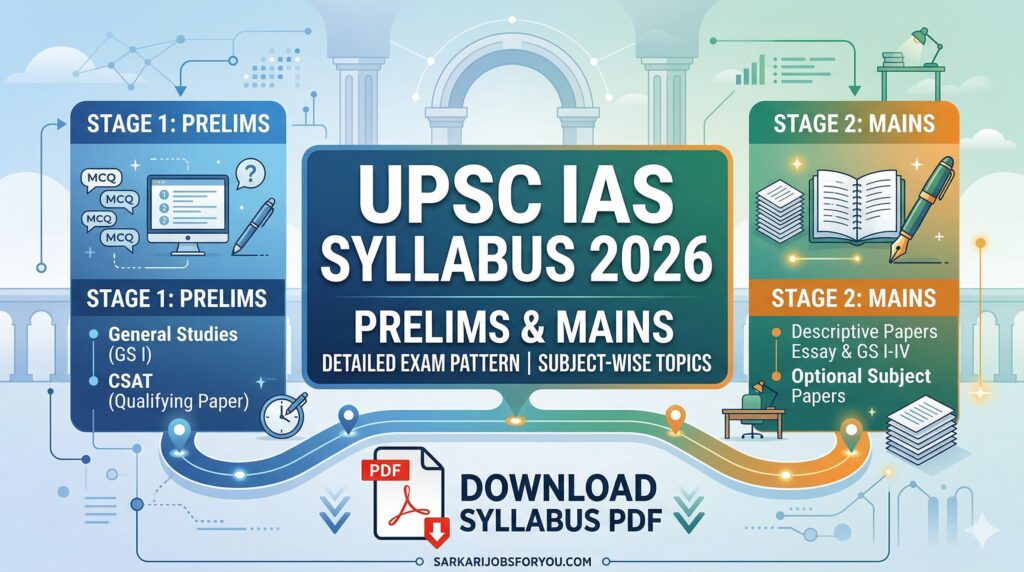
UPSC IAS Syllabus 2026: The Union Public Service Commission (UPSC) Civil Services Examination (CSE) is the gateway to India’s most prestigious administrative positions, including the Indian Administrative Service (IAS), Indian Police Service (IPS), and Indian Foreign Service (IFS). With the 2026 recruitment cycle approaching, it is vital for aspirants to master the syllabus early.
The UPSC exam is a year-long journey consisting of three stages: Preliminary (Screening), Mains (Written/Descriptive), and the Personality Test (Interview). In this exhaustive guide, we break down every section of the UPSC 2026 syllabus to help you rank higher in the merit list.
UPSC Civil Services Exam 2026 – Overview
| Feature | Details |
| Conducting Body | Union Public Service Commission (UPSC) |
| Exam Name | Civil Services Examination (CSE) 2026 |
| Total Vacancies | Expected 1000+ |
| Application Start Date | February 4, 2026 |
| Prelims Exam Date | May 24, 2026 |
| Mains Exam Date | August 2026 (Tentative) |
| Official Website | [suspicious link removed] |
UPSC Eligibility Criteria 2026
Before diving into the syllabus, ensure you meet the eligibility requirements for the 2026 cycle.
1. Nationality
- For IAS, IPS, and IFS: Must be a citizen of India.
- For other services: Citizens of India, subjects of Nepal/Bhutan, or Tibetan refugees (who came before 1962).
2. Educational Qualification
- A candidate must hold a graduate degree (Bachelor’s) in any discipline from a recognized university.
- Candidates in their final year of graduation can also apply for the Preliminary exam.
3. Age Limit & Number of Attempts (As of August 1, 2026)
| Category | Minimum Age | Maximum Age | Number of Attempts |
| General / EWS | 21 Years | 32 Years | 06 |
| OBC (Non-Creamy) | 21 Years | 35 Years | 09 |
| SC / ST | 21 Years | 37 Years | Unlimited (Until age limit) |
| PwBD | 21 Years | 42 Years | 09 (Gen/OBC) / Unlimited (SC/ST) |
Stage 1: UPSC Prelims Syllabus (Objective Type)
The Prelims stage consists of two compulsory papers of 200 marks each. Both papers follow a negative marking system where 1/3rd of the marks assigned to that question are deducted for every wrong answer.
Paper I: General Studies (GS)
- Current Events: National and International importance (Sports, Awards, Summits).
- History of India: Ancient, Medieval, and the Indian National Movement (Modern History).
- Indian & World Geography: Physical, Social, and Economic Geography.
- Indian Polity & Governance: Constitution, Political System, Panchayati Raj, Public Policy, Rights Issues.
- Economic & Social Development: Sustainable Development, Poverty, Inclusion, Demographics, Social Sector Initiatives.
- Environmental Ecology: Bio-diversity, Climate Change, and General Science.
Paper II: CSAT (Qualifying Paper)
- Reading Comprehension: Ability to understand and interpret complex passages.
- Reasoning: Logical reasoning, analytical ability, and general mental ability.
- Basic Numeracy: Numbers and their relations, orders of magnitude (Class X level).
- Data Interpretation: Charts, graphs, tables, data sufficiency (Class X level).
- Note: You must score at least 33% (66 marks) in this paper to be eligible for the Mains.
Stage 2: UPSC Mains Syllabus (Descriptive Type)
The Mains exam is the most critical part of the selection process. It consists of 9 papers, out of which 2 are qualifying and 7 are used for merit ranking.
Part A: Qualifying Papers (300 Marks Each)
- Paper A (Indian Language): Choose one language from the 8th Schedule of the Constitution.
- Paper B (English): Compulsory English paper focused on grammar, precis writing, and comprehension.
Part B: Merit Ranking Papers (250 Marks Each)
Paper I: Essay
Candidates are required to write two essays on various topics (Social, Political, Economic, or Philosophical).
Paper II: GS I (History, Geography & Society)
- Indian Heritage & Culture: Art forms, Literature, and Architecture from ancient to modern times.
- Modern Indian History: Significant events, personalities, and issues from the middle of the 18th century until the present.
- World History: Events from the 18th century (Industrial Revolution, World Wars, Colonization).
- Geography: Distribution of key natural resources, physical geography (earthquakes, tsunamis, volcanic activity).
- Indian Society: Diversity of India, Role of women, Poverty, Urbanization, Globalization.
Paper III: GS II (Governance, Constitution, Polity, Social Justice & IR)
- Indian Constitution: Historical underpinnings, evolution, features, amendments, and basic structure.
- Governance: Transparency, Accountability, E-governance models, and Role of Civil Services in a democracy.
- Social Justice: Welfare schemes for vulnerable sections, issues related to Health, Education, and Human Resources.
- International Relations: India and its neighborhood, bilateral/regional/global groupings, and international institutions (UN, WTO, IMF).
Paper IV: GS III (Technology, Economic Development, Bio-diversity, Environment, Security & Disaster Management)
- Indian Economy: Planning, mobilization of resources, growth, and employment.
- Agriculture: Major crops, irrigation, e-technology in aid of farmers, Food processing.
- Science & Technology: Developments and their applications in everyday life; IT, Space, Computers, Robotics, Nanotechnology, and Bio-technology.
- Environment: Conservation, environmental pollution, and degradation.
- Security: Linkages between development and spread of extremism; Role of external state and non-state actors in creating challenges to internal security (Cybersecurity, Money-laundering).
Paper V: GS IV (Ethics, Integrity, and Aptitude)
This paper tests the candidate’s attitude and approach to issues relating to integrity and probity in public life.
- Ethics and Human Interface: Essence, determinants, and consequences of Ethics in human actions.
- Attitude: Content, structure, function; its influence and relation with thought and behavior.
- Emotional Intelligence: Concepts and their utilities in administration and governance.
- Probity in Governance: Concept of public service, Information sharing, and transparency.
- Case Studies: Applying ethical principles to real-life administrative dilemmas.
Paper VI & VII: Optional Subjects
Candidates must choose one optional subject from a list of 48 subjects (e.g., History, Geography, Public Administration, Sociology, Anthropology, Literature of any language, etc.). This subject consists of two papers.
List of Optional Subjects for UPSC 2026
You can choose any one from the following popular options:
- Agriculture / Animal Husbandry
- Anthropology / Sociology
- Botany / Zoology
- History / Geography
- Public Administration / Political Science & IR
- Management / Commerce & Accountancy
- Economics / Law
- Mathematics / Physics / Chemistry
- Literature (Hindi, English, Sanskrit, etc.)
Stage 3: Personality Test (Interview) – 275 Marks
Candidates who clear the Mains cutoff are called for the Interview.
- Objective: To assess the personal suitability of the candidate for a career in public service.
- Focus Areas: Intellectual qualities, social traits, interest in current affairs, critical powers of assimilation, and leadership potential.
- Total Merit Score: 1750 (Mains) + 275 (Interview) = 2025 Marks.
Top Recommended Books for UPSC 2026
To master the 1000+ marks of General Studies, you must refer to these “Standard Books”:
- Polity: Indian Polity by M. Laxmikanth.
- Modern History: A Brief History of Modern India (Spectrum) by Rajiv Ahir.
- Ancient/Medieval History: NCERT Class 11th & 12th.
- Economy: Indian Economy by Nitin Singhania or Ramesh Singh.
- Geography: Certificate Physical and Human Geography by GC Leong.
- Art & Culture: Indian Art and Culture by Nitin Singhania.
- Environment: Environment by Shankar IAS.
- Ethics: Lexicon for Ethics, Integrity & Aptitude.
Preparation Strategy for UPSC 2026
- Step 1: NCERT Foundation: Read NCERTs from Class 6 to 12 for History, Geography, and Science.
- Step 2: Newspaper Reading: Daily read The Hindu or The Indian Express.
- Step 3: Answer Writing: Start writing one answer daily for Mains after 3 months of basic reading.
- Step 4: Mock Tests: Solve at least 40-50 Prelims test papers and 10-15 Mains test series before the exam.
Important Links
| Action | Link |
| Download Official UPSC Syllabus PDF | Click Here |
| Apply Online Link (UPSC OTR) | Click Here |
| Download Previous Year Papers | Click Here |
Frequently Asked Questions (FAQs)
Q1: How many marks are required to clear UPSC Prelims?
The cutoff for General category usually ranges between 85 to 95 marks in GS Paper I. Paper II (CSAT) only requires 66 marks.
Q2: Can I choose an optional subject different from my graduation?
Yes, UPSC allows you to choose any optional subject from the provided list, regardless of your educational background.
Q3: Is there any change in the UPSC 2026 syllabus?
As of now, the core syllabus remains the same. Any minor changes are usually updated in the official notification released in February.